
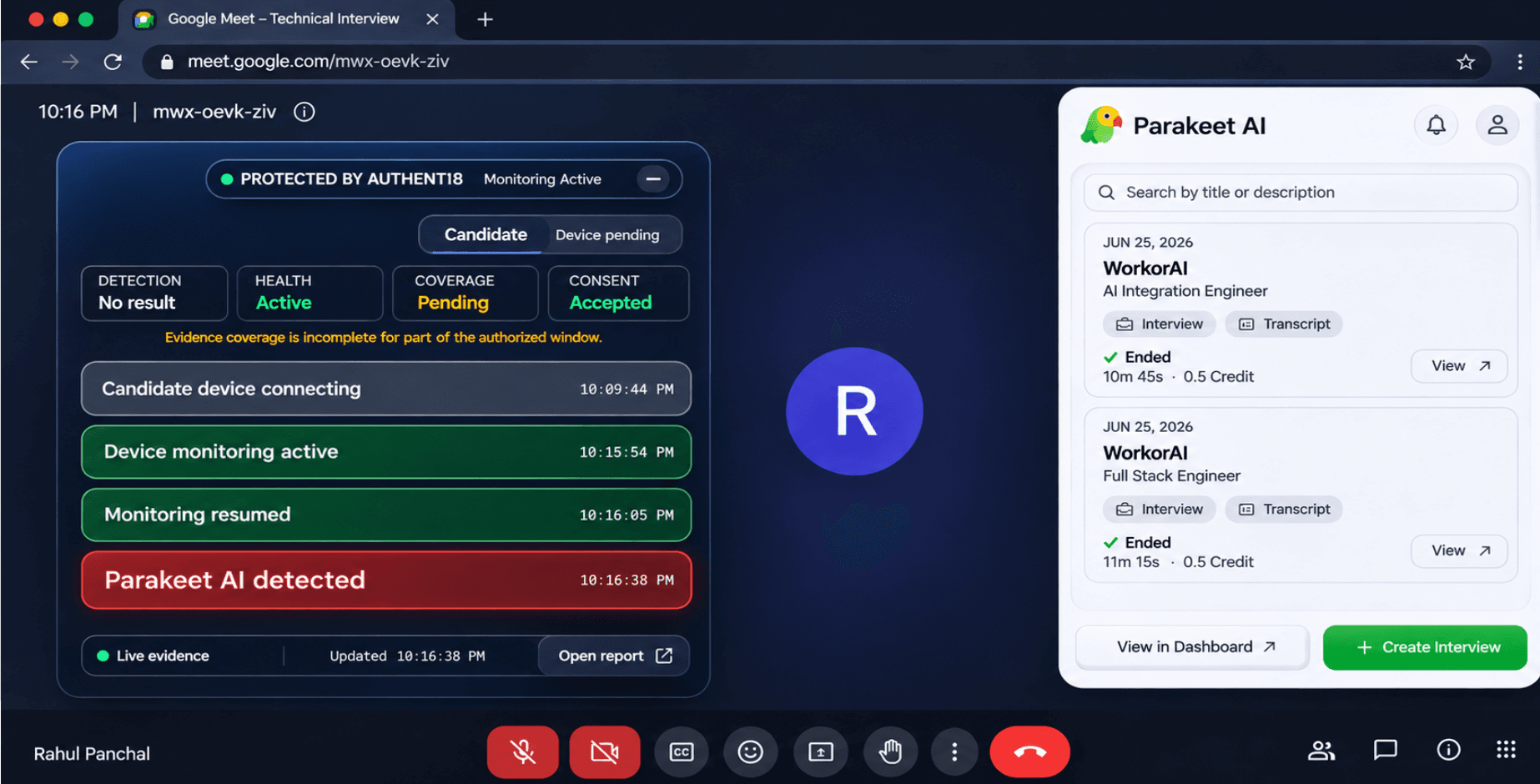
Detecting unauthorized AI assistance is a technical challenge
A video interview platform primarily facilitates communication. It is not necessarily designed to determine whether a participant is receiving outside assistance.
Interview-integrity software attempts to address parts of that visibility gap.
However, not all detection products work the same way.
Four broad approaches
Behavioral analysis
Some systems analyze observable behaviors such as gaze direction, response timing, or other interaction patterns.
These approaches require careful validation because behavior can have many explanations unrelated to misconduct.
Device or environment monitoring
Depending on permissions and implementation, some systems inspect device-level activity or enforce restrictions.
These methods can offer different visibility from a standard browser-based meeting but may require installation and additional privacy safeguards.
Technical-signal detection
These systems evaluate defined technical indicators associated with supported activities or applications.
Their effectiveness depends on the signals available, the operating environment, and the particular detection implementation.
Assessment-based verification
These methods focus on the candidate's ability to demonstrate knowledge through practical tasks, follow-up questions, and independent verification.
They help establish competence but do not necessarily identify which software is running.
How Authenti8 is approaching the problem
Authenti8 is building a technical-signal-based system for live interview integrity, initially focused on Google Meet.
The intended workflow is to surface relevant detection information to interviewers and support post-interview review.
Authenti8 is not positioning its approach around facial-expression interpretation, gaze tracking, or voice-based judgments of honesty.
What should an employer ask a detection vendor?
Before purchasing any interview-integrity software, ask:
- Which specific tools, versions, and environments are supported?
- What permissions or installation steps are required?
- What evidence is produced when a detection occurs?
- What is the measured false-positive rate?
- What happens when the system cannot observe a relevant signal?
- Can a candidate contest or clarify a detection event?
- How is interview-related data stored, accessed, and deleted?
A vendor that cannot answer these questions should not be trusted merely because its dashboard looks sophisticated.
Detection is not the same as a hiring decision
The NIST AI Risk Management Framework emphasizes managing AI risks through governance, measurement, and ongoing risk management. That is a useful model for evaluating any automated technology used in consequential decisions.
Final takeaway
The best interview-integrity technology is not necessarily the product making the strongest detection claim. It is the product whose capabilities, limitations, and evidence can be understood and evaluated.