
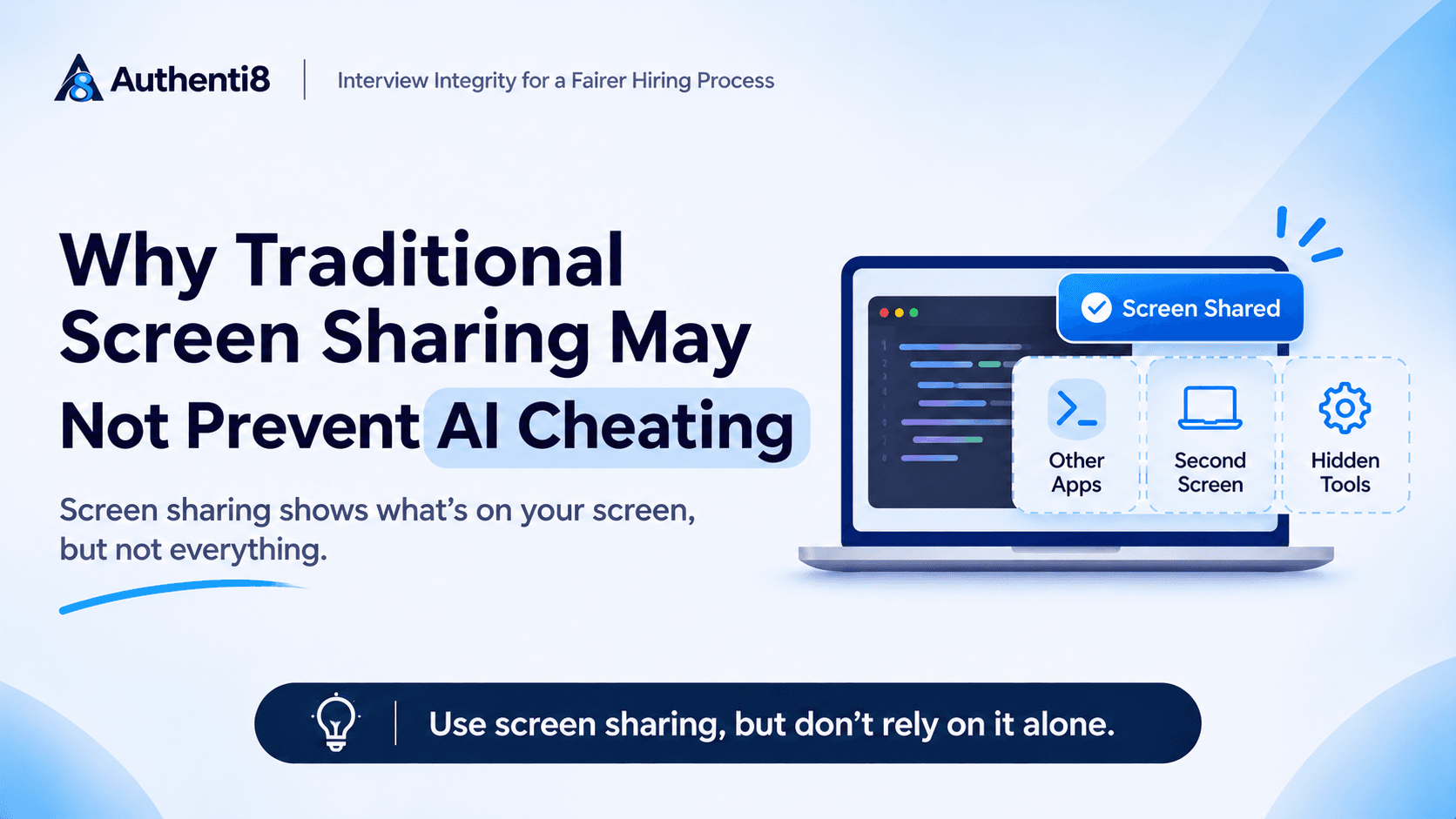
What does screen sharing actually prove?
During a remote technical interview, recruiters may ask candidates to share their entire screen.
This can help interviewers follow the candidate's work, inspect code, and understand how a solution is developed.
However, screen sharing provides visibility into a capture surface. It does not necessarily provide visibility into the candidate's entire environment.
That is an important technical distinction.
The visibility problem
A remote interview can involve several separate environments:
- Shared screen
- Other applications
- Other screens
- External devices
Why this matters for AI interview assistants
Parakeet AI's public documentation describes screen-capture exclusion behavior in its desktop product and different visibility characteristics in its browser product.
This is an example of why employers should not assume that everything relevant will appear in a screen share.
It does not mean every application behaves identically.
What should employers do instead?
Use screen sharing for its intended purpose: collaboration and visibility into work.
Combine it with a clear AI-use policy, structured technical assessments, and appropriate verification procedures.
If technical integrity tools are used, assess their coverage separately from the capabilities of the video meeting platform.
Does more monitoring always mean better integrity?
No.
Broader monitoring can introduce privacy risks, operational friction, and false confidence.
A more intrusive system is not automatically a more accurate one.
The appropriate goal is sufficient, relevant evidence with the least unnecessary collection of candidate information.
Final takeaway
Screen sharing remains useful, but it should not be presented as proof that a candidate is working without external assistance.