
AI is becoming part of everyday work
A software engineer may use an AI coding assistant to generate tests. A marketer may use AI to brainstorm campaign ideas. A customer-support representative may use an AI knowledge assistant.
If employees are expected to work with these tools, should candidates be prohibited from using them during interviews?
Not necessarily.
The answer depends on the skills the employer wants to evaluate.
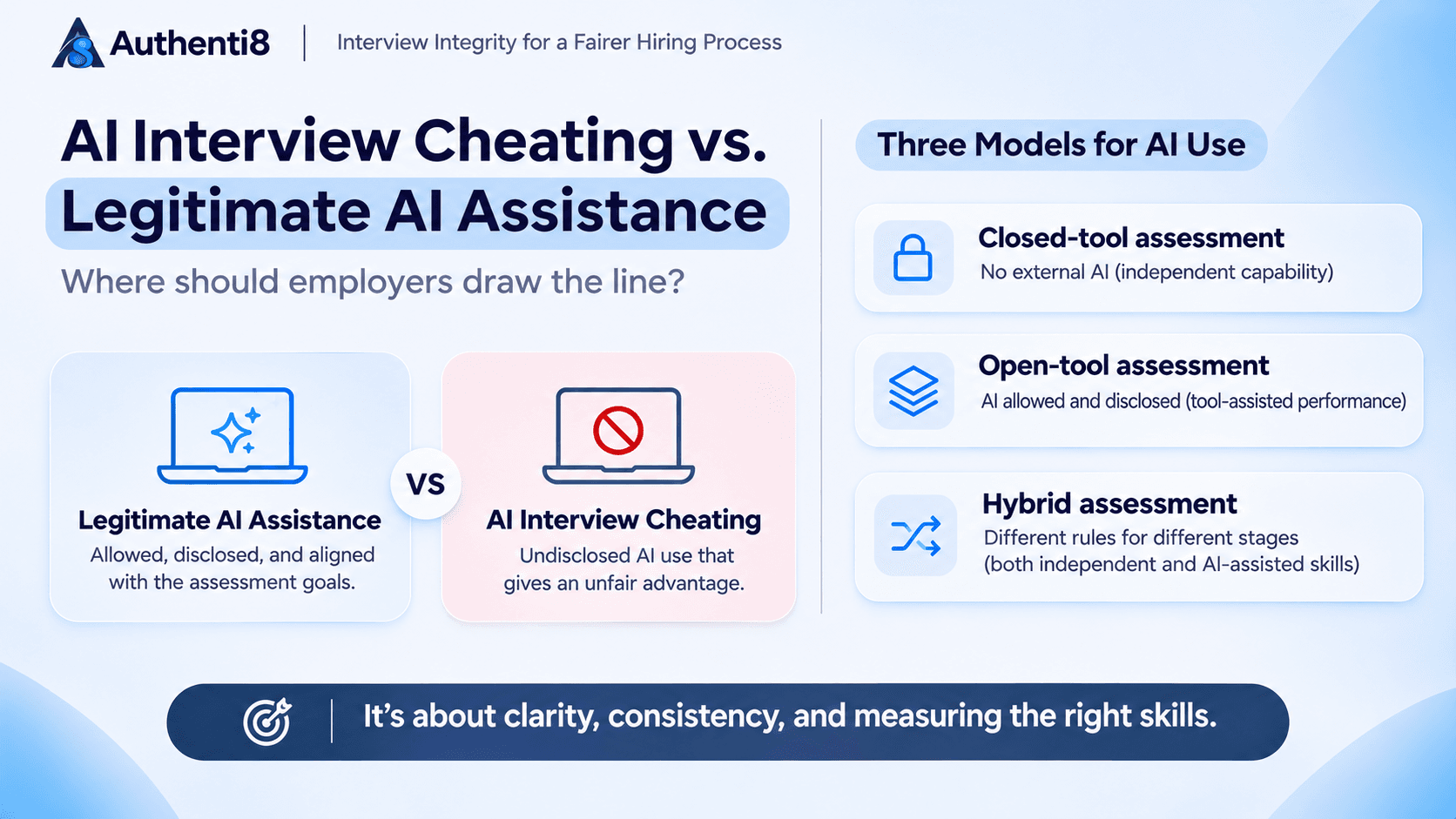
Three models for AI use during interviews
| Assessment model | AI policy | What it measures |
|---|---|---|
| Closed-tool assessment | No external AI assistance, subject to accommodations | Independent capability |
| Open-tool assessment | AI allowed and disclosed | Tool-assisted performance |
| Hybrid assessment | Different rules for different stages | Both independent reasoning and AI-assisted judgment |
Each model can be appropriate.
The problem arises when the employer and candidate operate under different expectations.
Why disclosure matters
Suppose two candidates complete the same assessment.
One answers independently. The other uses generated responses without disclosure.
If the interview is intended to measure independent reasoning, the candidates are no longer being evaluated under equivalent conditions.
Conversely, if AI is permitted, using it should not be treated as suspicious simply because another candidate chooses not to.
A sample AI-use policy
During this interview, we will evaluate your independent technical reasoning. Please do not use external AI systems to generate answers unless the interviewer explicitly permits them. Accessibility accommodations and approved assistive technologies are handled separately. If you are unsure whether a tool is permitted, please ask before using it.
For open-tool interviews, the policy should instead explain what tools are allowed and how candidates should disclose their use.
A better way to evaluate AI proficiency
Give candidates an AI-generated solution containing subtle errors.
Ask them to identify the problems, propose corrections, and explain how they would verify the result.
This evaluates an increasingly valuable workplace capability: knowing when not to trust generated output.
Final takeaway
Interview integrity is about clarity, consistency, and measuring the right skills—not treating all AI use as inherently dishonest.