
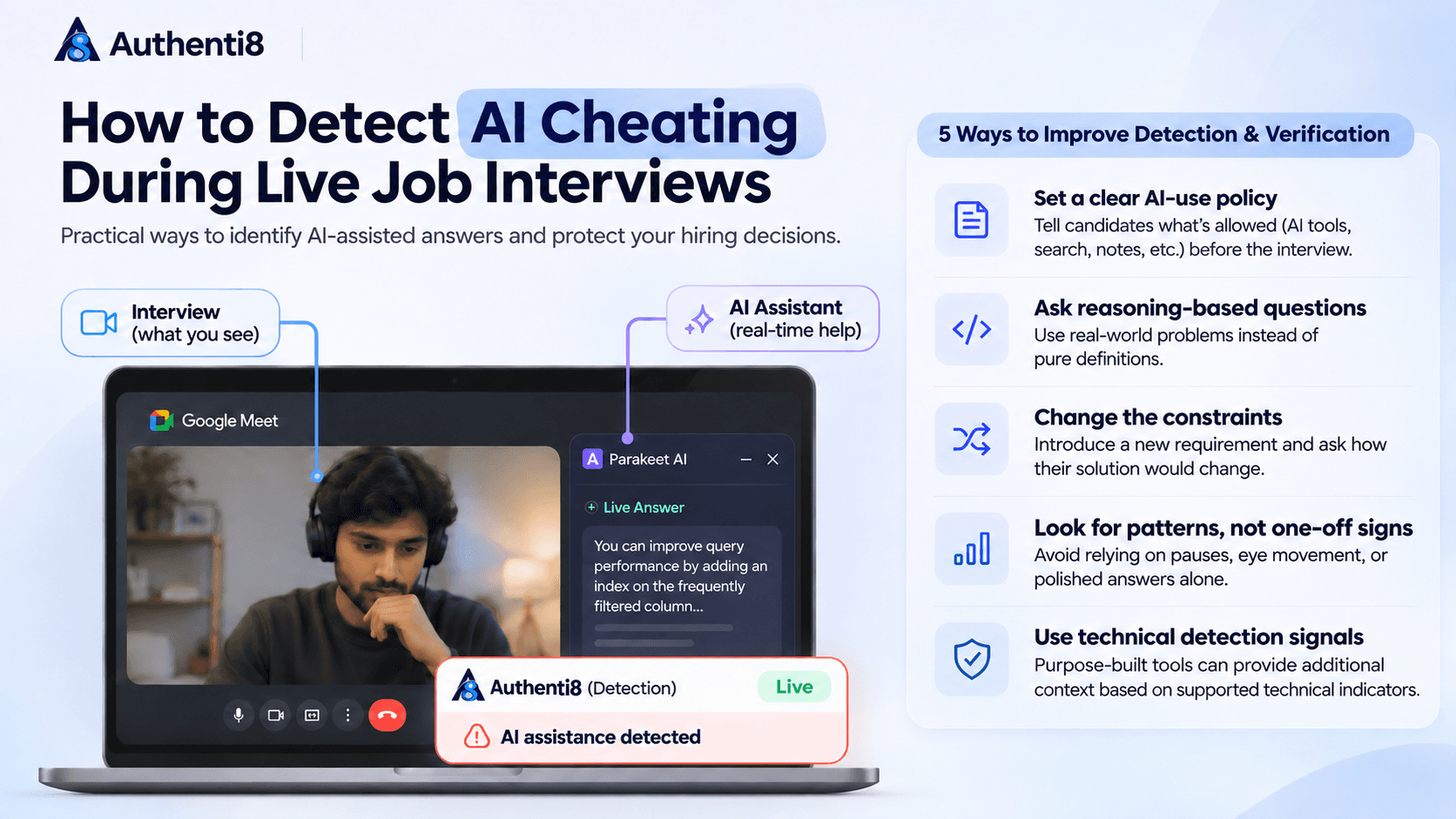
The interview answer is changing. The hiring challenge is not.
A candidate joins a technical interview, listens to a question, and provides a clear, structured answer. They explain the trade-offs, use appropriate terminology, and appear confident.
But the interviewer faces a difficult question: does the answer reflect the candidate's own understanding, or was it generated by an AI assistant?
This is not merely hypothetical. Research published in 2024 found that participants using ChatGPT assistance performed better in an experimental asynchronous video interview than those without it. The finding raises a concern about how effectively interview scores reflect unaided capability.
What does AI-assisted cheating look like?
During a remote interview, a candidate may use software that listens to questions, generates suggested responses, or provides contextual assistance.
Some tools operate outside the video meeting itself. Others provide overlays or use a separate device.
That distinction matters because the interviewer may only see the video call—not the full computing environment.
Five ways to improve detection and verification
Establish an AI-use policy before the interview.
Tell candidates whether AI tools, search engines, coding assistants, and notes are allowed. Without a clear policy, identifying a tool does not establish misconduct.
Ask questions that require reasoning.
Instead of asking candidates to define database indexing, give them a realistic query-performance problem and ask how they would investigate it.
Change the constraints.
After receiving an answer, introduce a new requirement. Ask the candidate to explain which parts of their solution need to change and why.
Look for patterns, not isolated behaviors.
Long pauses, unusual eye movement, or polished responses are not reliable proof of cheating. Nervousness, disability, language differences, and ordinary thinking can produce similar behaviors.
Consider technical detection signals.
Purpose-built integrity tools may provide additional information about supported technical indicators. Their coverage depends on the environment, permissions, and implementation.
Where Authenti8 fits
Authenti8 is developing a technical-signal-based approach to identifying potential AI assistance during live interviews, with Google Meet as its initial focus.
The goal is to provide interviewers with additional context while preserving human judgment.
A detection event should trigger review, not automatic rejection.
Final takeaway
The most effective defense is not a single trick or monitoring tool. It is a structured interview process supported by clear policies, practical assessments, and appropriately validated technology.