
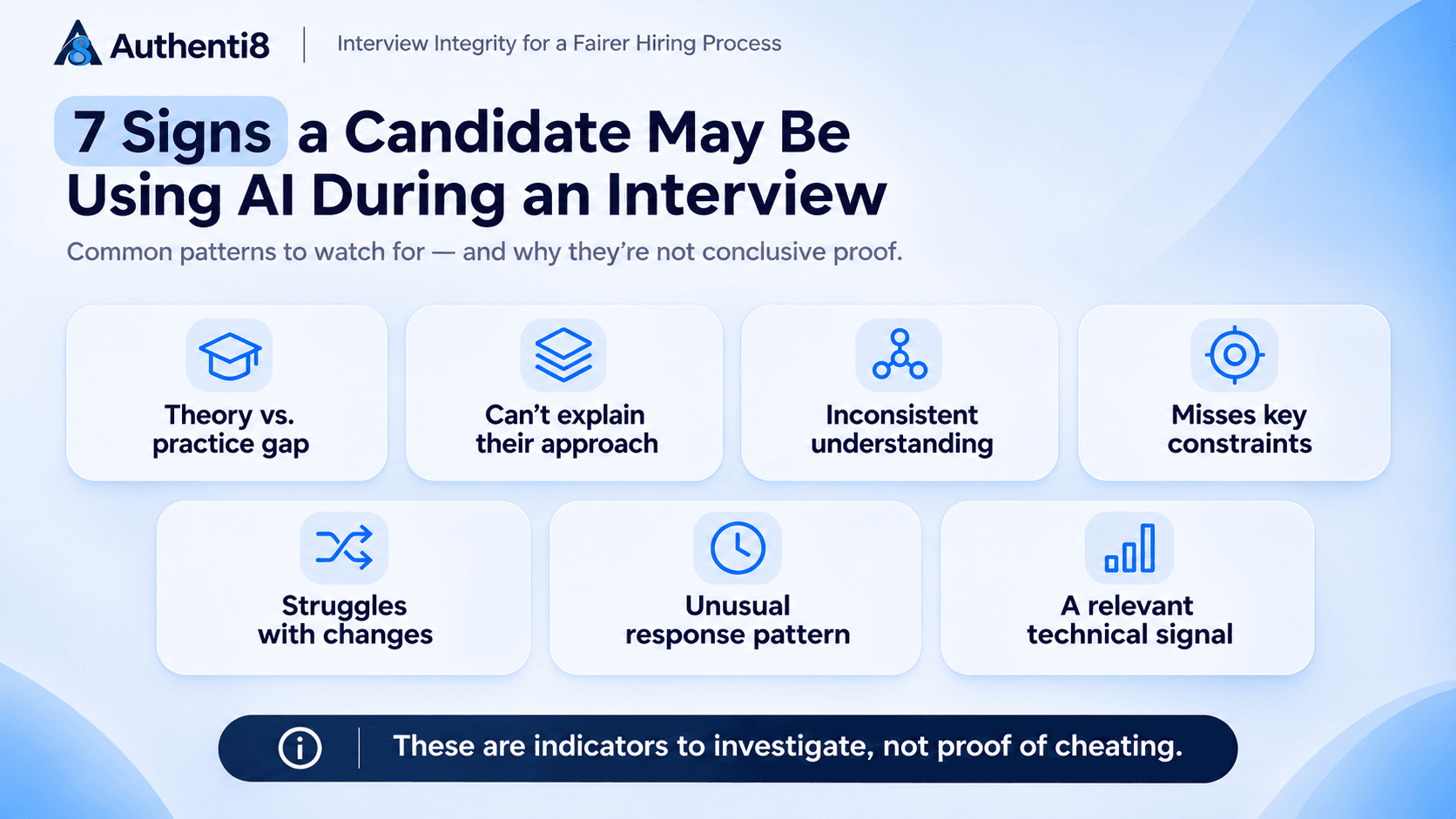
Why identifying AI assistance is difficult
Interviewers have always evaluated more than the words candidates say. They also assess reasoning, communication, and problem-solving.
Generative AI complicates that process because it can produce fluent, technically plausible answers.
But a polished response is not evidence of cheating.
The following seven patterns may justify additional assessment. None should be used as standalone proof of unauthorized AI use.
Seven patterns worth investigating
Strong theoretical answers but weak practical application.
A candidate explains a concept accurately but struggles to apply it to a realistic situation.
This may reflect memorization, limited experience, nervousness, or outside assistance.
Difficulty explaining their own solution.
Ask why a particular approach was chosen. Can the candidate explain the trade-offs and identify alternatives?
Inconsistent understanding across related questions.
A candidate may explain a complex architecture but struggle with an underlying concept. This is worth exploring, not automatically labeling suspicious.
Answers that do not address the actual constraints.
Generated responses may be generic or based on incomplete context. Human candidates can make the same mistake.
Difficulty adapting when requirements change.
Introduce a realistic constraint and observe how the candidate revises their approach.
Unusual response patterns.
Long delays followed by complete answers may prompt follow-up questions, but latency, language processing, anxiety, and accessibility needs are alternative explanations.
A relevant technical indicator from an integrity system.
A supported technical signal may provide additional context. Its reliability, coverage, and potential false positives must be understood before it influences a hiring decision.
A fair response to a concern
Ask a relevant follow-up question, document the candidate's answer, and evaluate it against a consistent rubric.
If the concern remains unresolved, consider an additional assessment with clearly communicated conditions.
Final takeaway
A good interviewer looks for evidence of skill, not evidence that confirms an initial suspicion.