
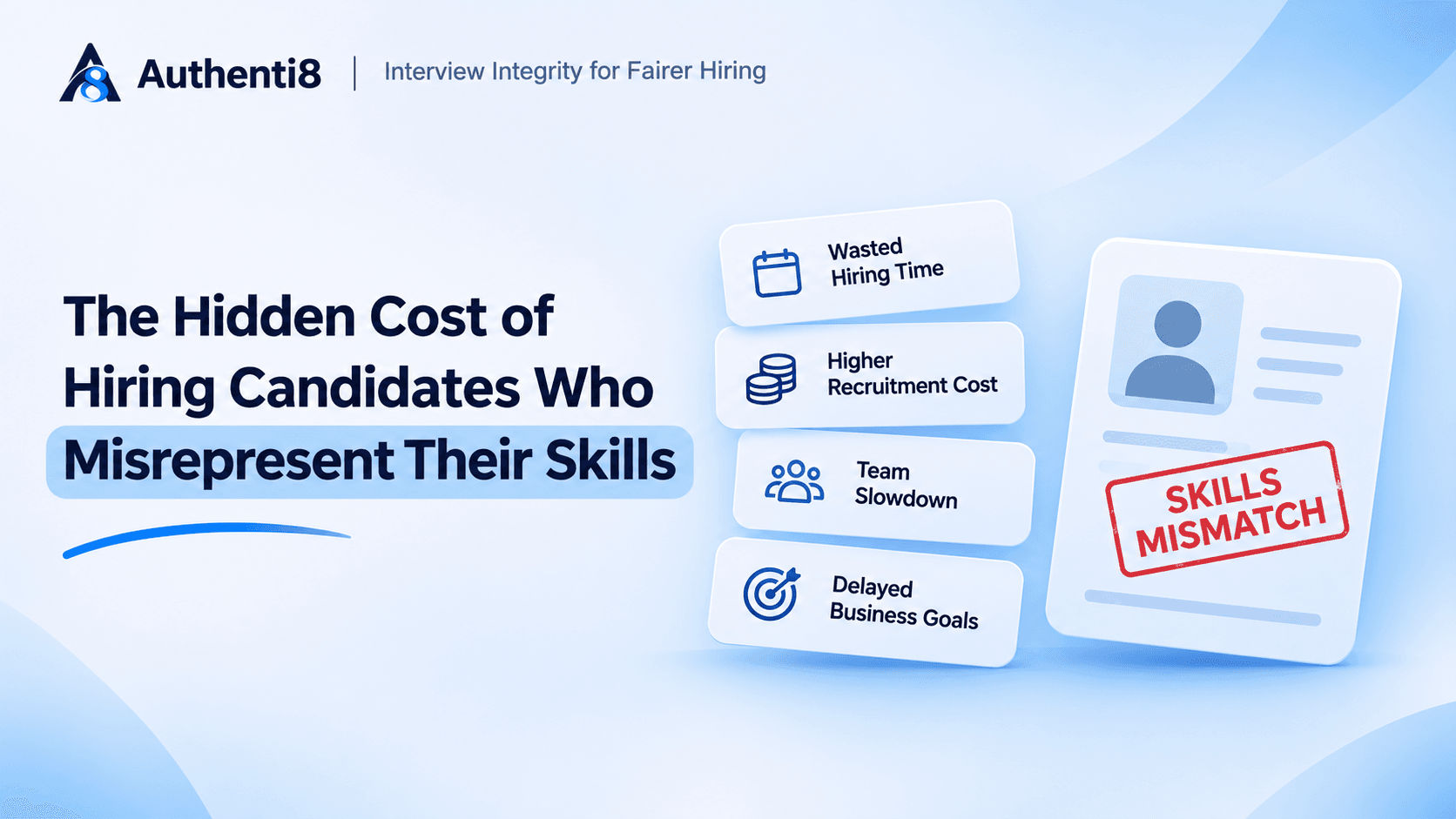
A hiring decision affects more than one person
When a company hires a software engineer, it invests in more than salary.
There is recruitment time, onboarding, mentorship, access provisioning, management attention, and the expectation that the employee will contribute to business goals.
If the hiring assessment fails to establish the required skills, those investments become more uncertain.
This does not mean every underperforming employee misrepresented their abilities. Performance can be affected by onboarding, unclear expectations, management, and workplace conditions.
But inaccurate skill signals are a preventable hiring risk.
How a mismatch affects an engineering team
Imagine a growing company hiring a backend developer.
The candidate performs well in interviews but struggles with the practical responsibilities of the role.
The company may need to invest additional time in training, reassign critical tasks, extend project timelines, or restart recruitment.
The impact can extend beyond the individual hire.
A practical way to model the cost
Instead of relying on a dramatic industry-wide statistic, companies can estimate their own exposure.
Illustrative hiring-mismatch cost model
Adjust the inputs to explore a hypothetical scenario. These are not Authenti8 customer results or industry averages.
Recruitment and team costs are totals for the whole scenario, not monthly amounts. Avoid counting the same expenditure twice.
₹80,000 × 2 + ₹40,000 + ₹30,000
This is a simplified scenario, not a net loss calculation. It excludes benefits received from the employee's work and other potential costs.
The connection to AI-assisted interviews
If an assessment is intended to measure independent ability, unauthorized generated answers may make the candidate appear more capable than the evidence justifies.
An experimental study of AI assistance in asynchronous interviews found that ChatGPT-assisted participants received higher scores than unassisted participants.
That finding does not prove those participants would perform poorly at work. It demonstrates why employers need to think carefully about what their assessments actually measure.
How to reduce hiring uncertainty
Use work-sample assessments, structured interview rubrics, reference checks where appropriate, and realistic expectations for the role.
Assess candidates consistently rather than reacting to individual impressions.
Where Authenti8 fits
Authenti8 is focused on adding integrity information to live interviews. It is not a substitute for evaluating technical competence, nor can it guarantee the performance of a future employee.
Final takeaway
A stronger hiring process reduces uncertainty by collecting better evidence of actual capability.