
The way we interview is changing. But trust still matters.
Imagine interviewing a software engineer for your team.
You ask a technical question. The candidate responds confidently, explains the concepts, and provides a well-structured solution.
Everything seems right.
But there's a question you might not have considered:
Are you evaluating the candidate's actual technical knowledge, or answers generated by an AI assistant?
Real-time AI assistance tools such as Parakeet AI, Cluely, and Chiku AI are changing how candidates can participate in online interviews.
These tools can provide contextual assistance and suggested responses while an interview is happening.
AI assistance is not inherently dishonest. However, when an interview is intended to assess independent technical ability, undisclosed use of prohibited AI tools can undermine the reliability of the evaluation.
That's the problem we're working to solve at Authenti8.
How the idea for Authenti8 started
Before building Authenti8, our founder, Rahul Panchal, was working on Alena an AI-powered mock interview platform.
The goal was to help candidates prepare for interviews, practice their communication skills, and improve their performance.
While building that product, he observed how effectively AI could generate structured responses to technical interview questions.
That led to a different question:
If AI can help someone prepare for an interview, what happens when the same technology is used to generate answers during a live assessment without the interviewer's knowledge?
Consider a company hiring a backend engineer.
The interviewer wants to understand whether the candidate can debug production issues, design scalable systems, and explain architectural decisions.
But if the candidate is secretly relying on generated answers during a closed-tool assessment, the interviewer may receive an inaccurate picture of the candidate's independent capabilities.
That observation became the starting point for Authenti8.
Introducing Authenti8
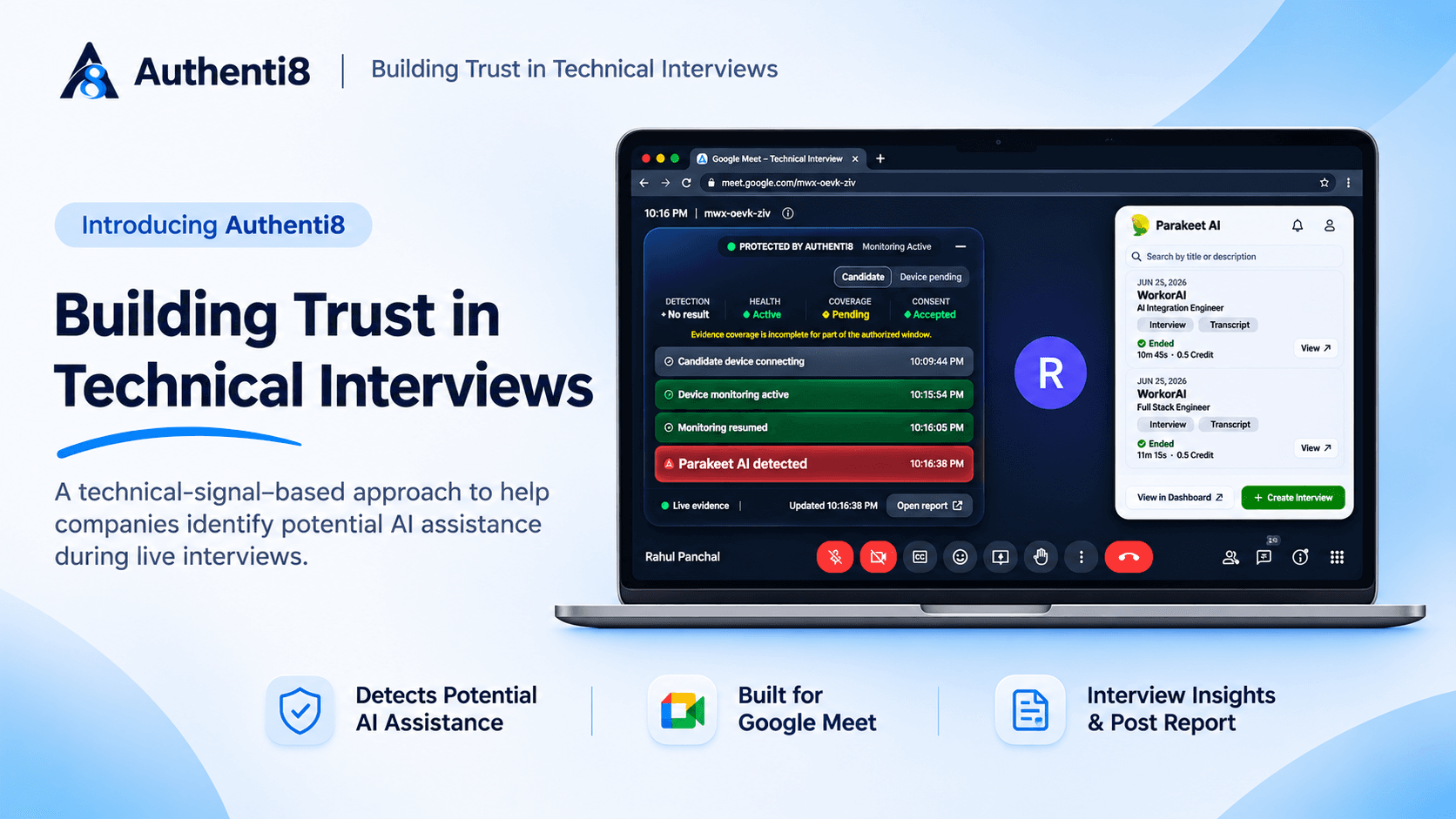
Authenti8 is an HRTech startup building technology to help companies identify potential AI assistance during live technical interviews.
Our initial focus is Google Meet.
Rather than attempting to determine whether someone is honest based on their facial expressions, eye movements, or speaking patterns, we're developing a technical-signal-based approach.
Our goal is to provide interviewers with relevant technical information that can help them review potential unauthorized AI assistance.
We are working toward an experience that includes:
- Live technical detection signals: Identifying supported technical indicators associated with potential AI assistance.
- Google Meet integration: Bringing interview-integrity information into an existing interview workflow.
- Interview evidence and reporting: Helping interviewers review relevant events during and after an interview.
- Human-led decisions: Keeping responsibility for interpreting evidence and making hiring decisions with the employer.
The effectiveness of technical detection depends on the tools, versions, operating environments, permissions, and signals supported by the implementation.
We believe those limitations should be communicated clearly rather than hidden behind broad detection claims.
Why we're taking a different approach
Not every unusual interview response is evidence of cheating.
A candidate may pause because they're thinking. They may look away while working through a problem. They may communicate differently because of language, disability, or individual preferences.
None of those behaviors proves that someone is using an AI assistant.
We don't believe candidates should be judged based on assumptions about how an honest person is supposed to look or sound.
Instead, our approach focuses on defined technical indicators.
Even then, a technical alert should not automatically result in rejection.
Detection information should support investigation and human judgment—not replace them.
Where Authenti8 stands today
We're still early in our journey, but we've made meaningful progress.
We've built our minimum viable product (MVP) and started an early soft launch with Bloorush.
This has given us an opportunity to collect feedback, understand real interview workflows, and identify areas where the product needs improvement.
We've also spoken with more than 100 founders, CTOs, and HR professionals to better understand the challenges companies face when evaluating candidates.
These conversations have helped us explore the need for better interview integrity, particularly as real-time AI assistance becomes more accessible.
However, conversations and early feedback are not the same as independently validated detection accuracy.
Our next priorities include improving product reliability, testing supported detection scenarios, and learning how technical hiring teams want to review and act on integrity information.
What we believe about the future of hiring
AI is becoming part of everyday professional work.
Software engineers use AI coding assistants. Marketing teams use AI to generate ideas. Businesses increasingly use AI to improve productivity.
We don't believe companies should reject those developments.
In fact, when AI proficiency is relevant to a role, employers should consider assessing how responsibly candidates can use these tools.
But there is an important difference between an interview that explicitly allows AI and one intended to measure independent reasoning.
Both can be useful.
What matters is that the rules are clear and the evaluation measures the intended skills.
We believe trustworthy hiring requires four things:
Clear expectations:
Candidates should know which tools are permitted.
Better assessments:
Interview questions should measure practical, job-relevant capabilities.
Responsible technology:
Integrity tools should provide understandable evidence with clearly communicated limitations.
Human judgment:
Hiring teams should evaluate concerns fairly and give candidates an appropriate opportunity to clarify them.
Authenti8 is building technology to support this broader approach.
Our vision: Helping companies hire with greater confidence
A hiring decision can shape a company's future.
For an early-stage startup, a new engineer may become one of the people responsible for building its core product.
For a growing company, hiring the right technical talent can influence delivery timelines, team performance, and customer experience.
These decisions deserve reliable evidence.
Our vision for Authenti8 is straightforward:
Help companies evaluate candidates based on demonstrated skills while protecting fairness and trust throughout the interview process.
We know that technology alone cannot guarantee a good hire.
But we believe that combining better assessments, responsible technical safeguards, and informed human decisions can make hiring more reliable.
We're building Authenti8 one step at a time, learning from employers, improving our technology, and staying transparent about our progress.
And we're just getting started.
Building a more trustworthy future for technical interviews
If you're a founder, CTO, recruiter, or technical hiring manager facing challenges with AI assistance during interviews, we'd love to hear about your experience.
We're especially interested in understanding how your team evaluates candidates today and where you believe additional integrity information could help.