
The problem with traditional technical interviews
Many technical interviews still depend on predictable questions.
Candidates are asked to define concepts, solve familiar algorithm problems, or describe architectures they may have studied repeatedly.
These formats can be useful, but they are not always sufficient to evaluate independent problem-solving.
AI assistance makes this limitation more important.
Start with the capability you need to measure
Before selecting interview questions, define what successful performance looks like.
For a backend engineer, this might include:
- Diagnosing production failures.
- Understanding database trade-offs.
- Writing maintainable code.
- Explaining security implications.
- Communicating technical decisions.
An interview should generate evidence for these capabilities.
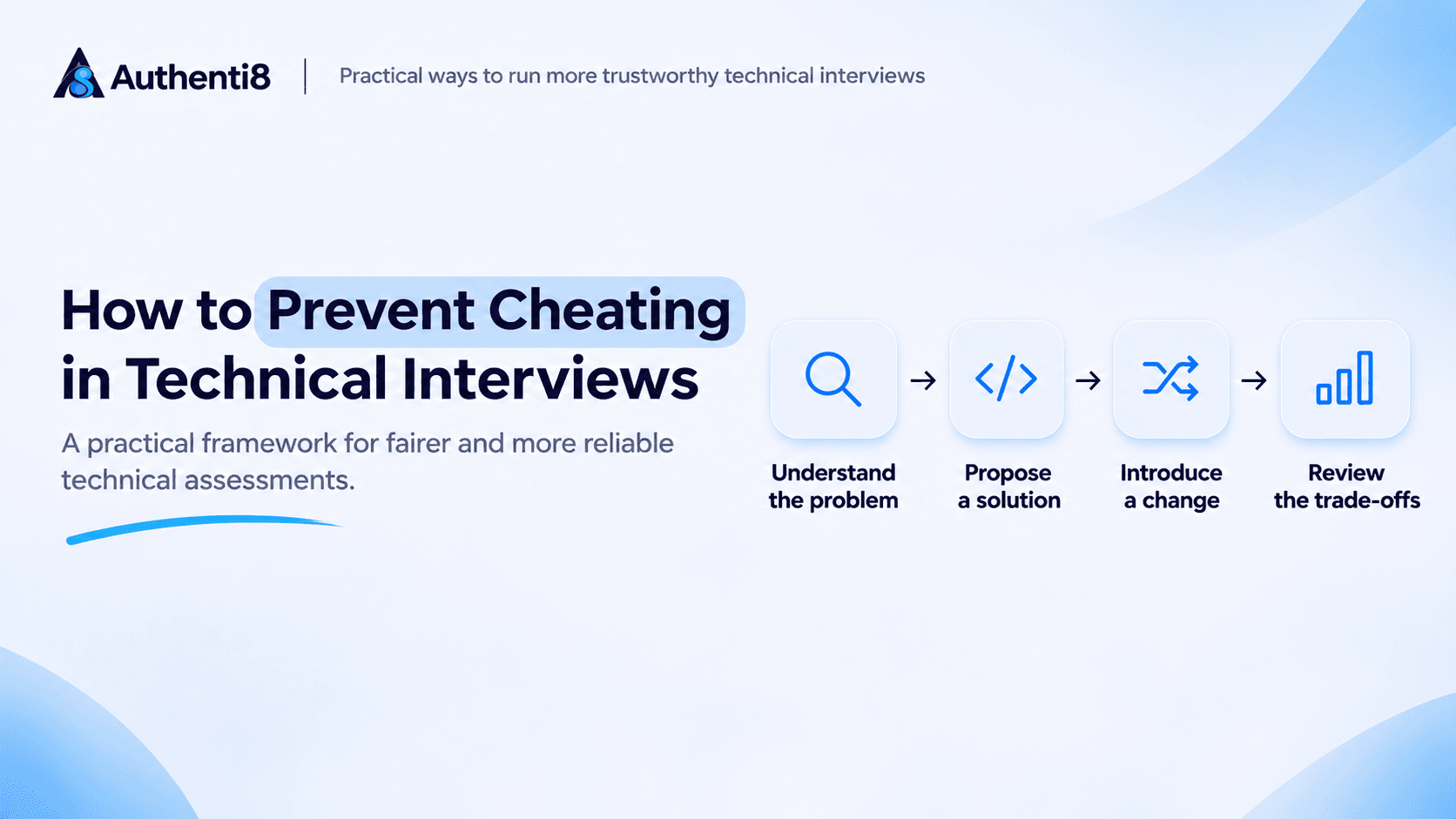
A four-stage technical interview
Understand the problem.
Give the candidate a realistic engineering scenario and ask clarifying questions.
Propose a solution.
Ask for an implementation approach and underlying assumptions.
Introduce a change.
Add a failure scenario, scalability requirement, or security constraint.
Review the trade-offs.
Ask what the candidate would monitor, test, and improve in production.
Example: a backend engineering interview
Instead of asking, "What is Redis?", present this scenario:
An API handles 10,000 requests per minute. A frequently accessed database query is creating latency spikes.
Ask the candidate how they would diagnose the issue.
After they propose caching, introduce cache invalidation and stale data.
Then ask what happens when Redis becomes unavailable.
This evaluates practical reasoning and architectural understanding.
It is still possible for someone to consult AI during the exercise. The benefit is that the assessment produces richer evidence of competence.
Add safeguards without creating an adversarial experience
Tell candidates what tools they may use. Apply consistent scoring criteria. Offer appropriate accommodations.
Technical monitoring, where used, should be proportionate, disclosed, and reviewed by people who understand its limitations.
Final takeaway
Cheat-resistant technical interviews should resemble real engineering work rather than trivia competitions.